BREAK
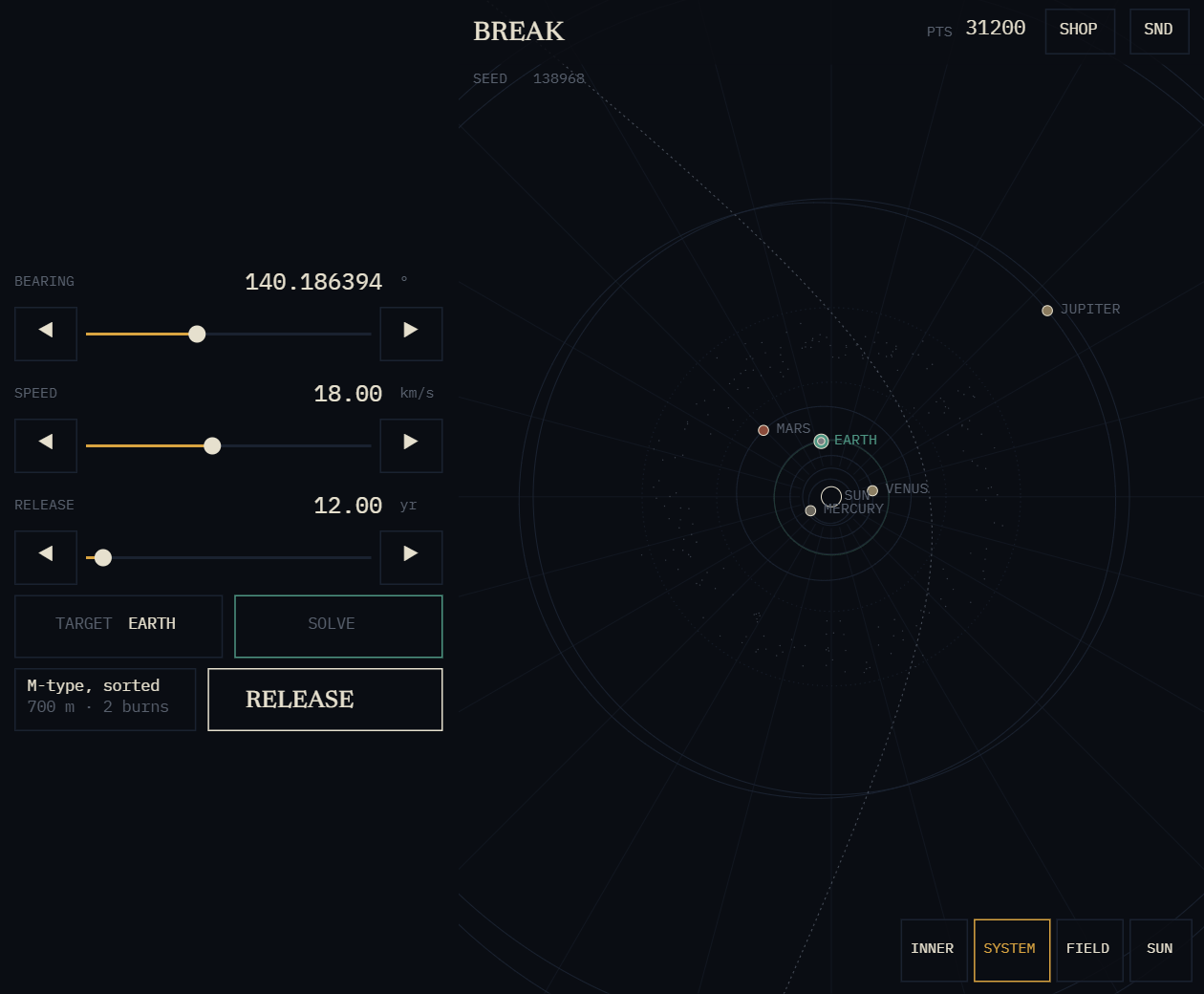
You are outside the solar system and you have a rock. You pick a bearing, a speed, and a year to let go. Then you watch for the next few thousand years.
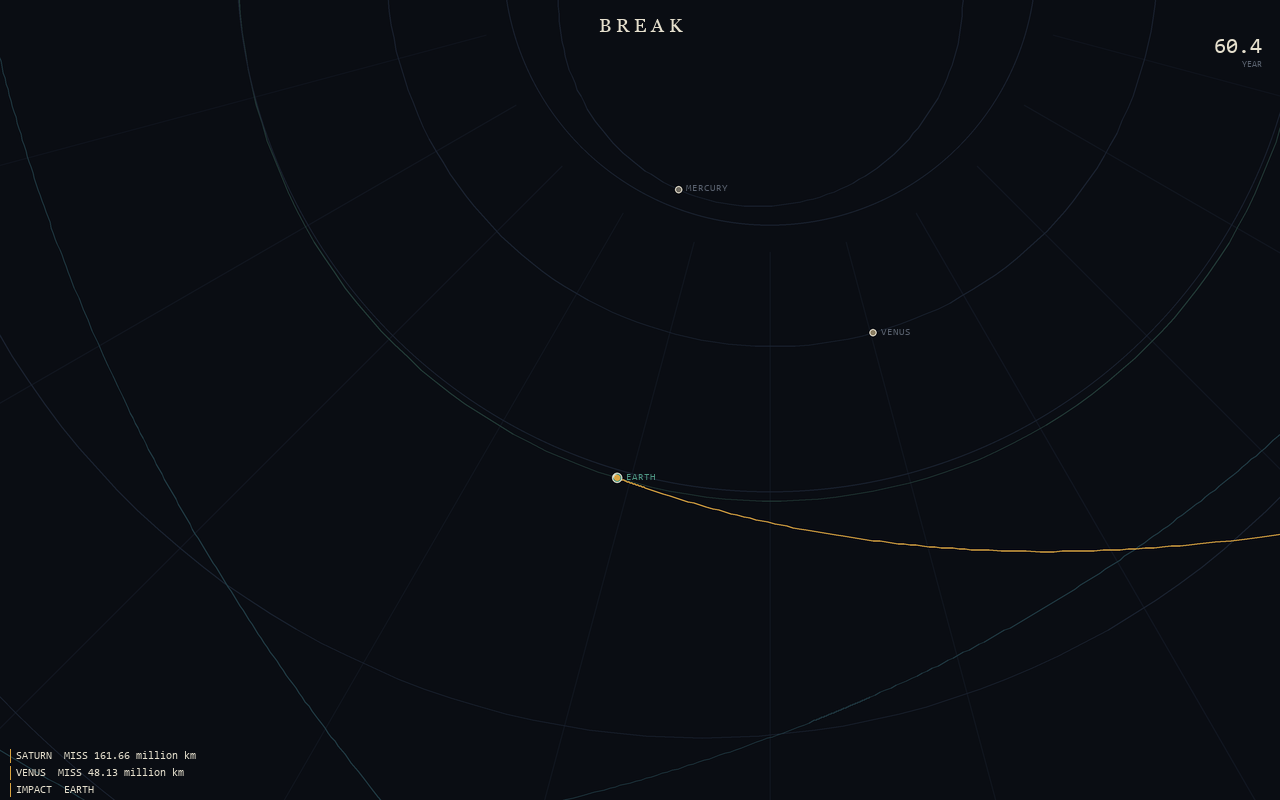
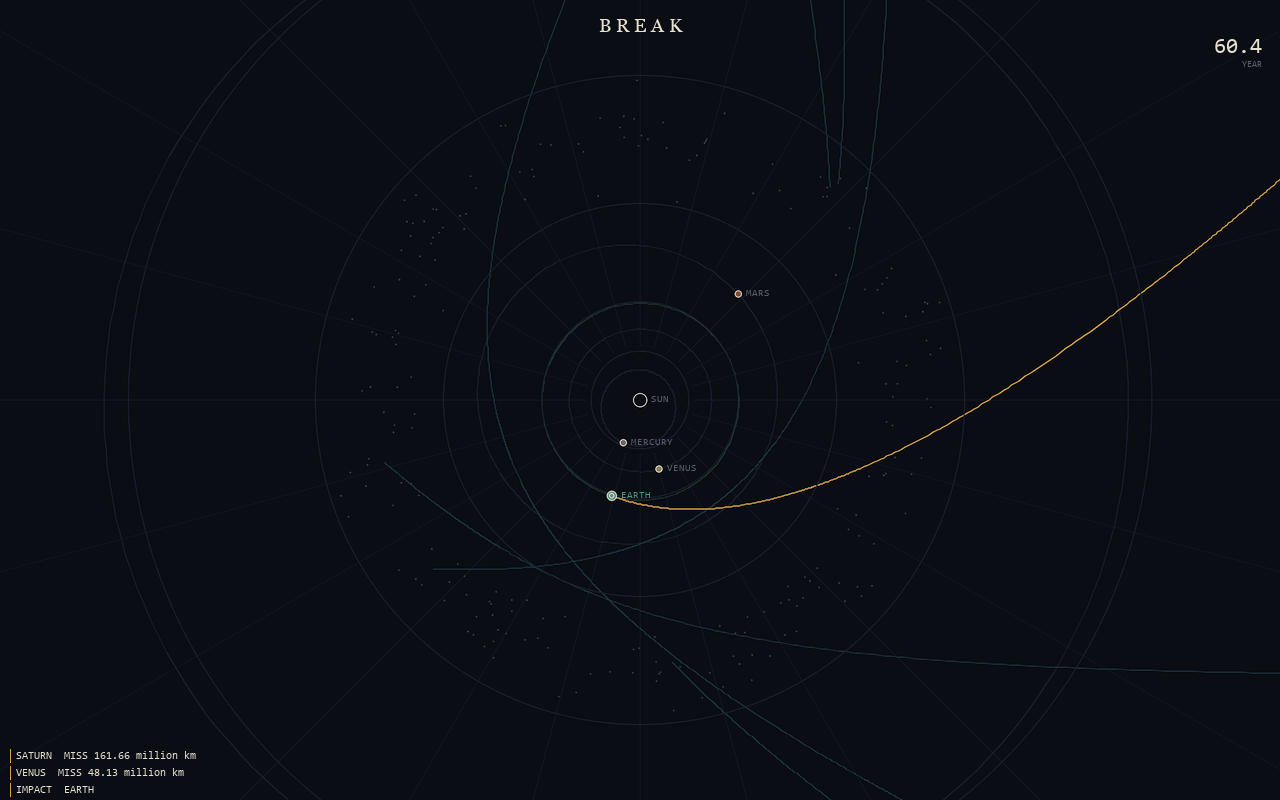
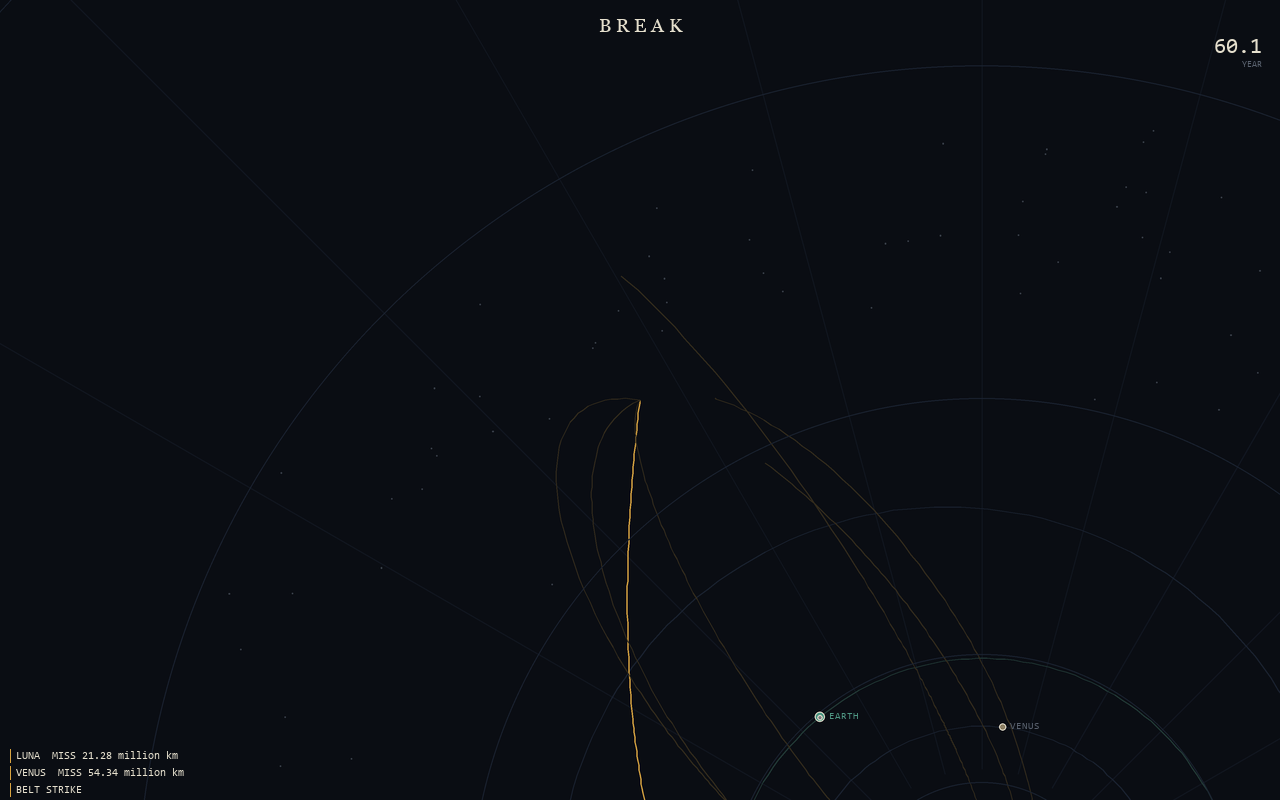
The rock is on its own after that. Nine bodies pull on it. There is a rock belt at 2.5 AU that it can hit, and if it does, the pieces keep flying and can hit things themselves. Earth is 6,371 km across and one astronomical unit away, and it does not stay still.
Most shots leave the solar system and never come back.
How hard is it, exactly
I fired 24,000 shots with random settings and counted.Eight of them hit Earth. That is one in three thousand.
The rest:
Where a blind shot ends up
- Leaves the solar system for good | 94.9%
- Still drifting after 50,000 years | 4.6%
- Hits some planet | 0.40%
- Falls into the Sun | 0.05%
- Hits Earth | 0.033%
Half of all shots never get closer to Earth than 1.09 AU, which is further away than the Sun.
Two percent pass inside the Moon's orbit. Four in a thousand get within ten Earth radii and still miss.
Jupiter got hit sixty times in the same 24,000 shots. Eight for Earth, sixty for Jupiter.
Jupiter is five times further away and it still catches seven rocks for every one that finds us. It is eleven times wider and it pulls much harder. Most of what it does not catch, it throws somewhere else on the way past.
And that number is generous, because everything in this game happens in one flat plane. A shot only has to be aimed correctly left and right. A real rock has to be aimed correctly up and down as well. Spread the same aim over a few degrees of inclination and one in three thousand becomes something like one in a million.
You can aim, of course. With the solver on, most people land one in fifteen to forty tries.
That is the game. The one in three thousand is what it costs to not aim.
For comparison, the actual sky
These are published estimates from the planetary defence literature, not output from this simulation. They are rough and the ranges are wide.
- 20 m (Chelyabinsk, 2013) | every 50 to 100 years
- 50 m (Tunguska, 1908) | every few hundred years
- 140 m | every 20,000 years
- 1 km | every 500,000 years
- 10 km (the one that ended the Cretaceous) | every 100 to 200 million years
Nothing currently known is on course to do the bottom row. The point of the table is the shape of it. Small and often, or large and almost never.
What is actually simulated
Planets sit on analytic Kepler orbits, solved directly for whatever date you ask about.
Semi-major axes and eccentricities match published values to about a tenth of a percent.
The rock is a massless test particle on velocity Verlet, half a day per step, dropping to 0.0005 days when it gets within 0.01 AU of something. Collisions are tested against the swept path between steps, so nothing tunnels through a planet at 40 km/s.
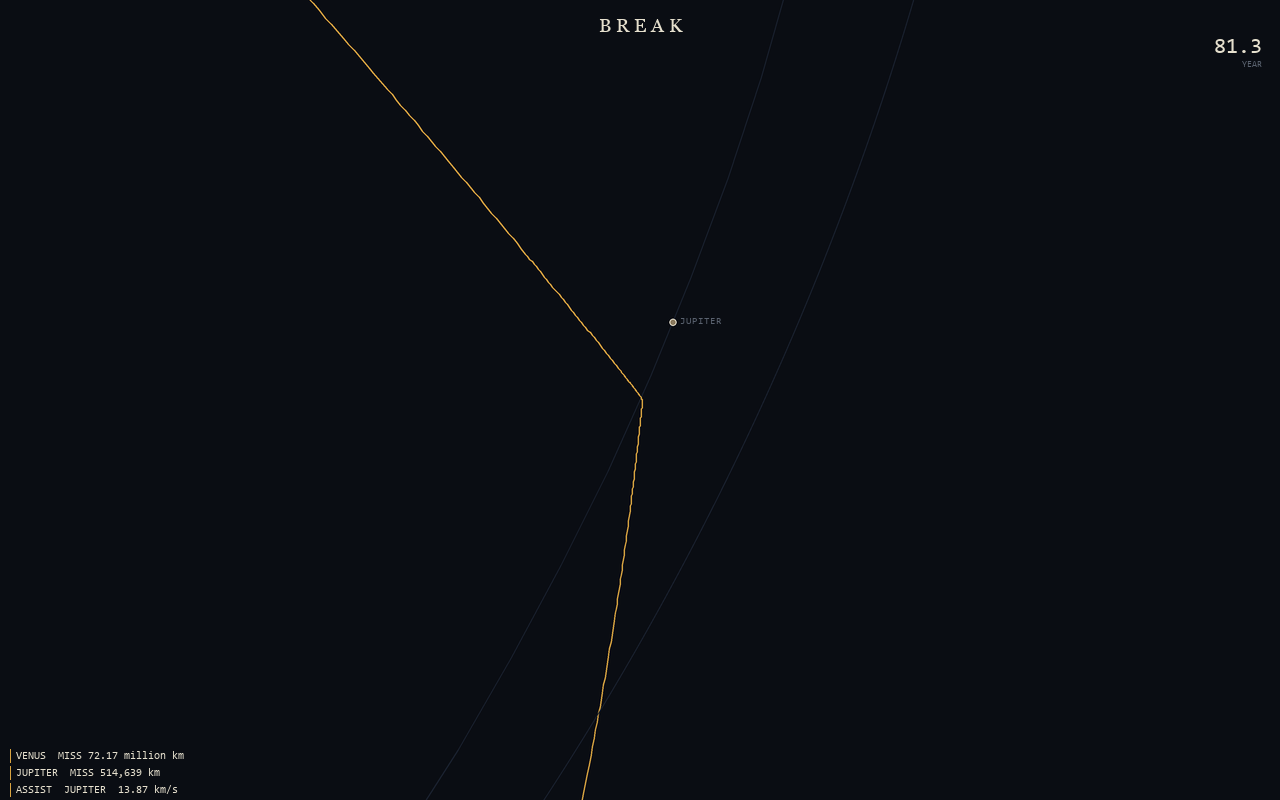
Gravity assists are the interesting part. Bending falls off with the square of speed:
| approach speed | passing Jupiter at | it turns by |
- 5 km/s | 1 million km | 113 degrees
- 10 km/s | 1 million km | 68 degrees
- 20 km/s | 1 million km | 28 degrees
- 45 km/s | 1 million km | 7 degrees
So a slow rock can be thrown almost anywhere and a fast one basically ignores Jupiter. If you want the giant planets to do your aiming, you have to arrive slowly and wait longer.
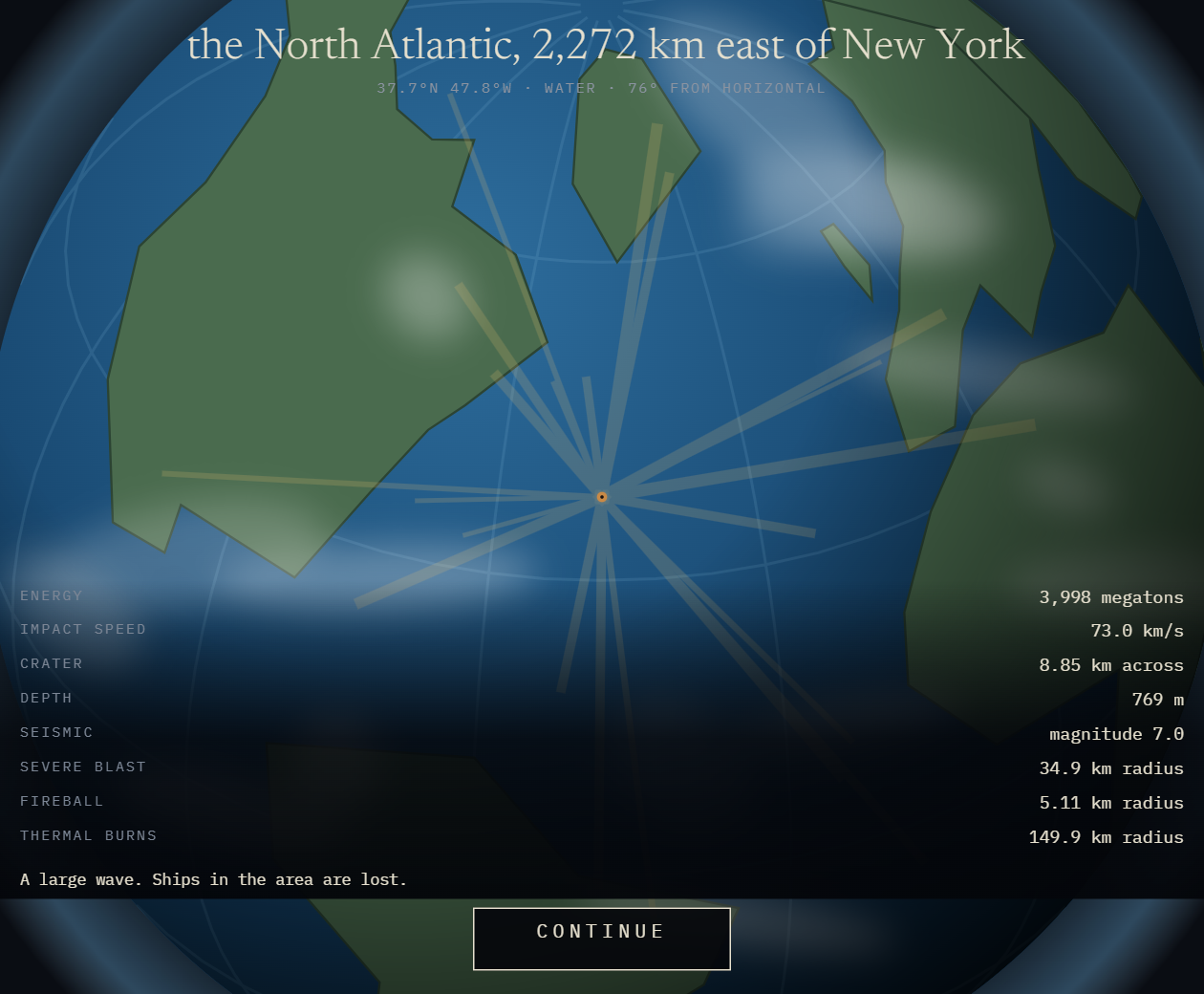
Crater sizes, seismic magnitudes and blast radii use the Collins, Melosh and Marcus scaling from 2005, the same relations behind the Earth Impact Effects Program. When something lands, the game names the place and tells you what happened there.
Same seed and same three numbers give the same shot every time, to the last digit.
What you can break
You start with a 200 metre rubble pile. It makes a three kilometre crater and ruins a region. Points buy larger rocks and better aiming, and the ladder goes up a long way past anything sensible. There are four outcomes above "large crater", and they are energy thresholds rather than scripted scenes: Earth's gravitational binding energy is 2.242e32 joules, and the game checks whether you delivered more than that.
Most players will not see the top of the ladder. That is intentional.
Controls
Three numbers: bearing in degrees, speed in km/s, release year. Drag the sliders, use the arrows, or type a value. Bearing takes six decimals because a thousandth of a degree is a million kilometres by the time the rock arrives.
SOLVE aims for the currently selected target, with a small error so you still have to work.
Bigger rocks carry correction burns you can spend mid flight.
Runs in a browser, on a phone as well. One HTML file, no engine, no libraries, no build step, nothing to install.
Leave a comment
Log in with itch.io to leave a comment.