


ABORT
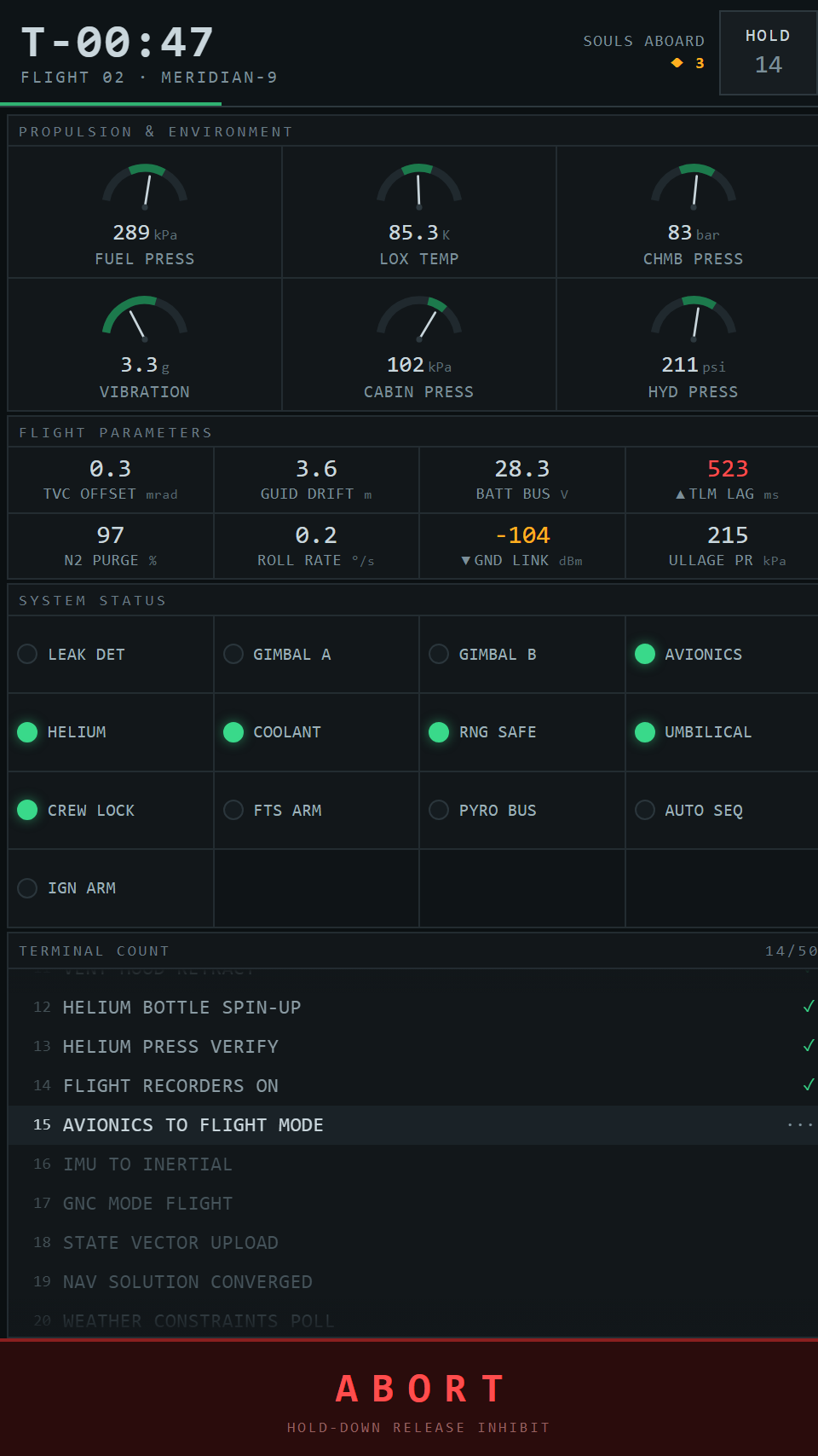
ABORT is a launch console. A wall of gauges, a fifty-item checklist scrolling at its own pace, a terminal count across the top, and one control.
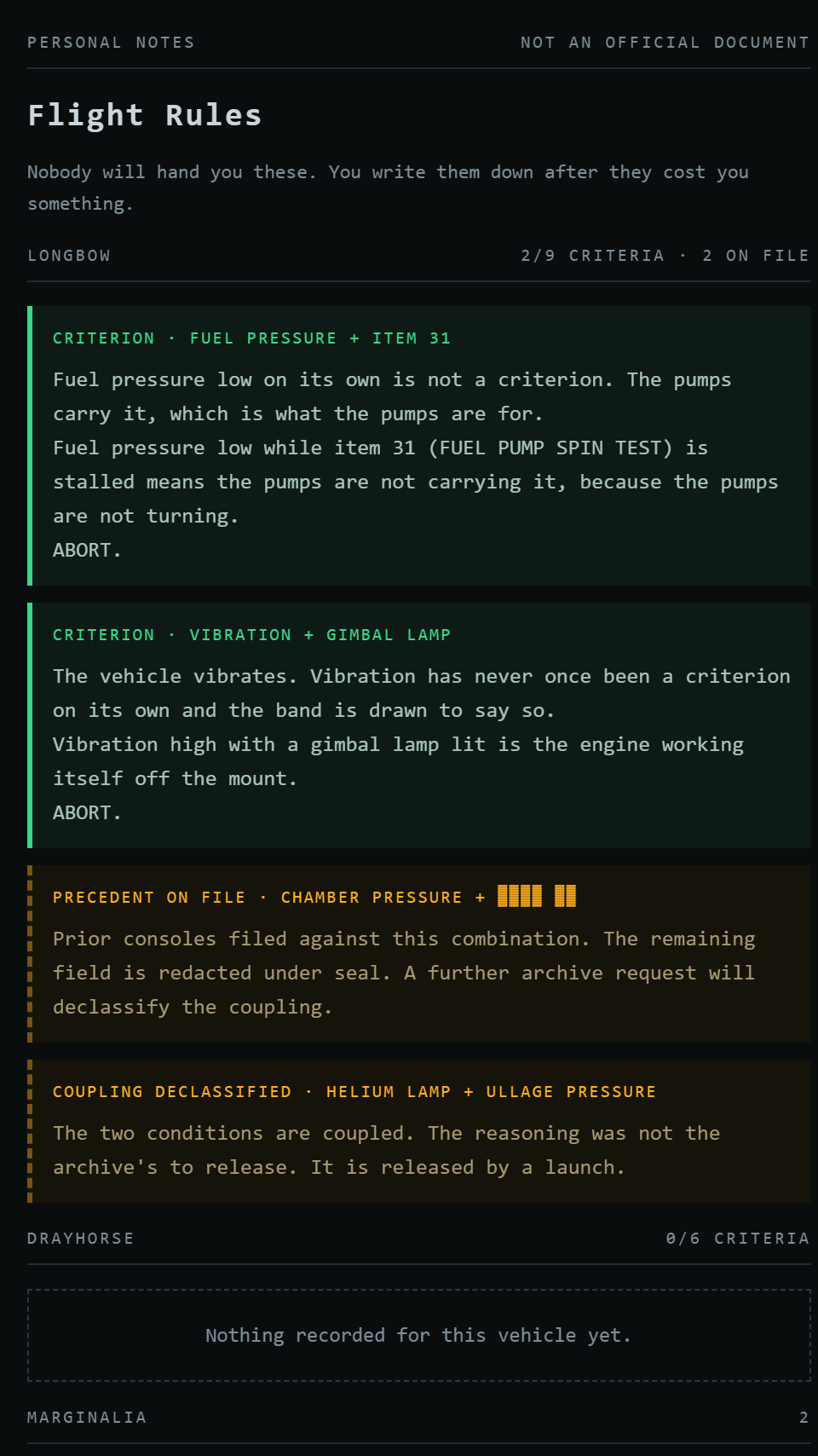
No single reading is an abort criterion. Combinations are. Fuel pressure low on its own is nothing, because the pumps carry it. Fuel pressure low while the pump spin test has stalled means the pumps are not carrying it, and that is a launch you stop.
Nobody issues you the criteria. The manual covers every channel on the board and does not cover which channels matter together, because that document does not exist. The people who knew were promoted, retired, or reassigned, and none of them wrote it down. You assemble the rulebook one flight at a time, the way they did.
Three channels lie on every count. Vibration leaves its band constantly. Telemetry lag spikes because of the ground network, not the vehicle. They are loud and they are never evidence. Sitting still while the board shouts is most of the skill.
The count
The countdown is the mechanic rather than a timer attached to one, and it does four jobs. It is the evidence window: every second is more data, so waiting is correct right up until it is not. It is the checklist clock, because a stalled item is half of most criteria. It is the score, since a correct abort is graded on the seconds you had left.
And it is the failure condition twice over. Let it reach zero with a live fault and the vehicle is lost. A few faults run on their own fuse and destroy the rocket before zero, which is the moment the count stops being the thing you are racing.
HOLD freezes the clock for fourteen seconds across the whole launch. It buys reading time and not safety. The gauges keep drifting and the checklist keeps scrolling while it is held, and spending it all scrubs you for schedule.
Consequences
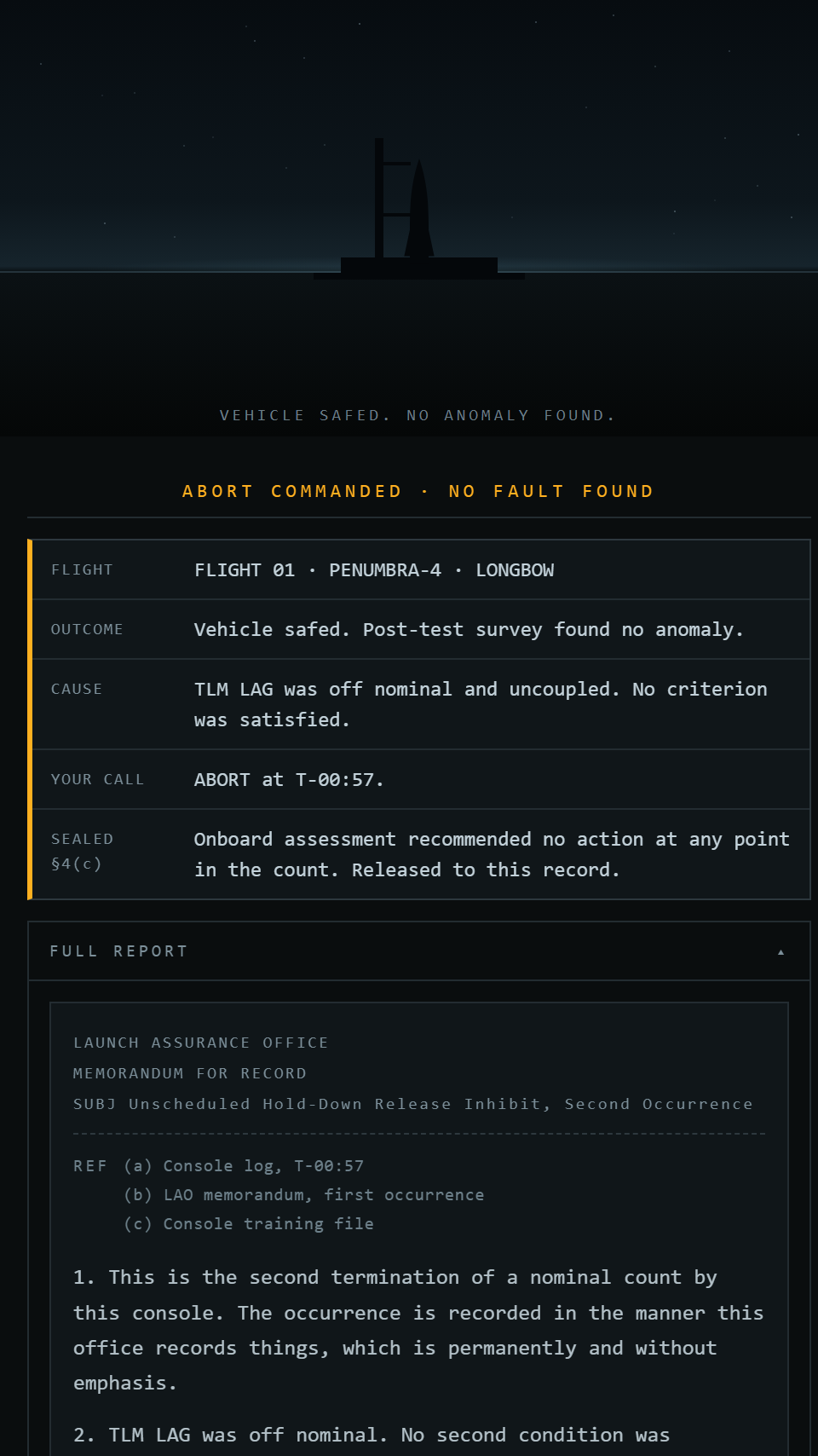
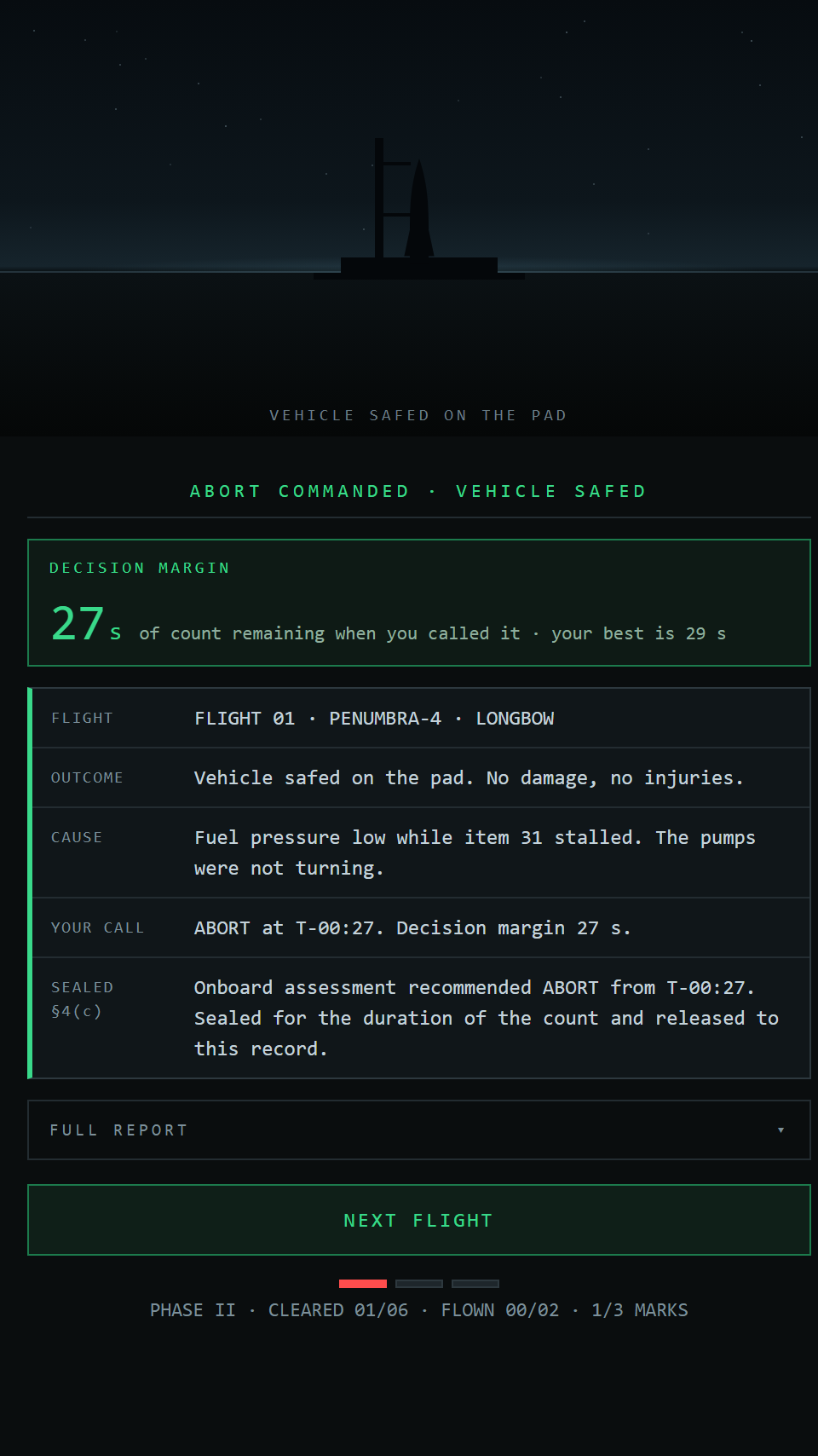
A correct abort safes the vehicle and writes the criterion into your notes. A correct launch flies. A missed abort loses the rocket, in silhouette, with a plume.
An abort on a healthy vehicle produces no explosion at all. It produces a memorandum from the Office of Launch Assurance, which is worse. Three marks on your record and you are reassigned to a telemetry archive six hundred and fifty feet underground in a salt mine in Kansas, where nothing drifts.
Three vehicles
LONGBOW is a medium liquid rocket, where you learn to read couplings at all.
DRAYHORSE is a heavy lifter on two solid boosters, which cannot be shut down, throttled, or reasoned with once lit. Whatever you are going to notice, notice it before item 47.
KITE is a crewed spaceplane. Its fuel cells fail the way a career fails: gradually, respectably, with every individual reading still inside its band. Here you read trends instead of positions.
Eighteen flights of campaign. An endless Open Shift afterwards.
The paperwork is a mechanic
Public Law 41-118 forbids automating the abort decision, on the committee's finding that a system cannot be called to give evidence, cannot be suspended, and cannot be reassigned. So the onboard computer calculates the correct answer for the entire count and is required by statute to seal it until the flight is over. Every debrief shows you what the machine knew and was not permitted to say.
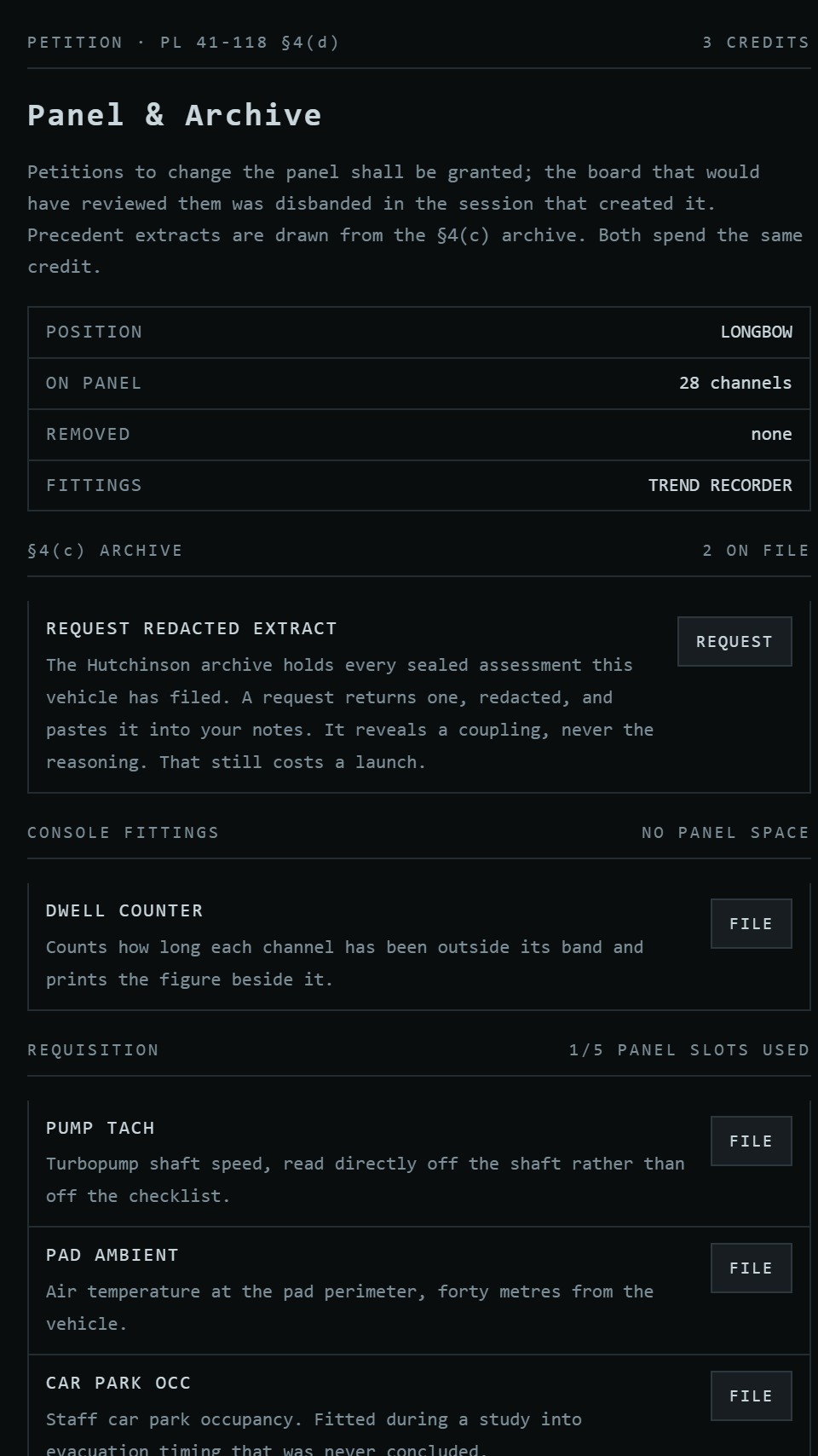
The same statute lets you petition to bolt instruments onto your panel, or plate over the ones that lie. Removing a liar removes your view of the condition and not the condition.
You can also requisition redacted precedent files from the archive, which name a coupling and withhold the reasoning. The reasoning is not for sale. That still costs a launch.
Notes
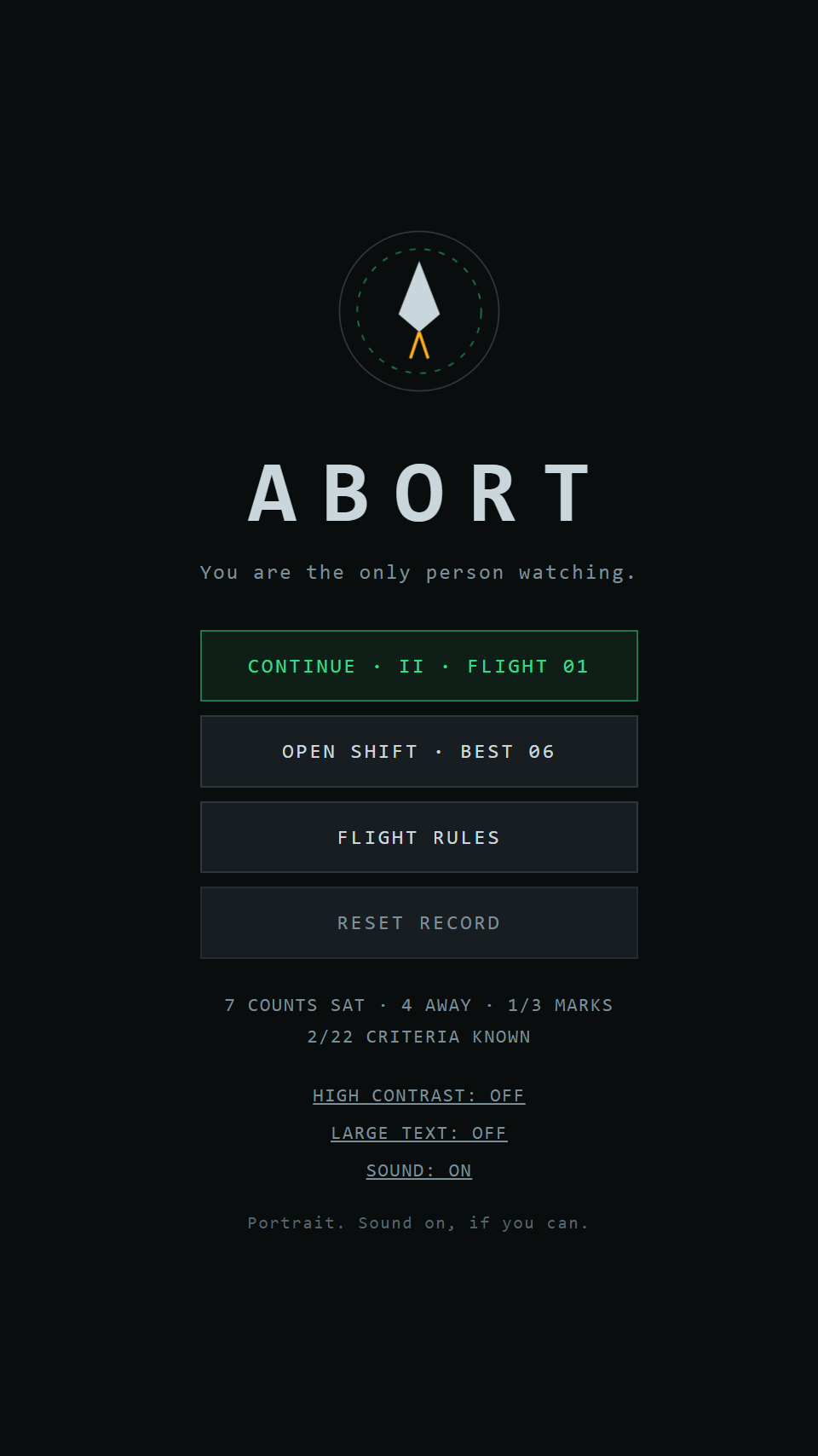
Runs in the browser. Portrait. Sound recommended.
Colour-blind and large-text modes are on the title screen. Channel state is never carried by colour alone: lamps differ in shape, and out-of-band channels carry a direction glyph.
Occasionally the correct answer is to do nothing while every alarm on the board is sounding. Those are the launches people abort. Alarms are not evidence.
Credits
No external assets. There are no image files in this build: every gauge, lamp, rocket and plume is drawn at runtime from hand-written CSS and SVG. There are no audio files, and all sound is synthesised live in the Web Audio API. No engine, no libraries, no build step, no bundled fonts. Typeface is the system monospace stack.
Code and writing are original to this jam and were produced with AI assistance for programming and prose. No generative AI was used for any art or audio asset, on this page or in the game. The cover image and screenshots are direct captures of the running build.
Comments
Log in with itch.io to leave a comment.
The game is somewhat confusing but it is a decent game. I would like some tips on how to complete it though.
The whole idea is to find the tips by trial and error. They are recorded in the Flight Rules after each flight. It's a bit like "Papers Please" but faster pace and in a space control center.